Build Your Own AI Girlfriend: Free Custom Generator Walkthrough (2026)

SexRoulette
Skip the tube. Talk to a real person on cam, free
Anonymous 1-on-1 video chat. Tap next any time.
· No sign-up. No history. Tap next anytime.
There are two ways to get an AI girlfriend. The first is to scroll a library of pre-made companions until one catches your eye — you pick her the way you'd pick a profile on a dating app, based on a face and a bio someone else wrote. The second is to build her: choose the hair, the eyes, the body type, the little details like a scattering of freckles or a tattoo on one shoulder, and give her a name and a backstory that's entirely yours. Same end result — an AI companion you can talk to, generate images of, and grow attached to. Wildly different starting point.
If you've ever swiped through a companion library and thought "close, but not quite," this article is for you. We're going to walk through exactly what "building" an AI girlfriend means in 2026 — what's genuinely customizable, what's still limited industry-wide, and how to actually do it, step by step, using Secrets.ai's custom generator as the working example. By the end you'll know precisely what to expect before you start clicking through a wizard yourself.
This isn't a marketing overview written by someone who's never opened the tool. It's a practical, section-by-section walkthrough — the kind of thing you'd want bookmarked in another tab while you actually go through the process yourself, so you know what each screen is going to ask before you get there and what choices are worth slowing down on.
Who Actually Builds a Custom AI Girlfriend (and Why)
It helps to be specific about who ends up choosing the build path over the browse path, because the motivations aren't identical.
Some people arrive with an extremely clear mental image — a specific hair color and body type combination, maybe inspired by someone from real life, fiction, or just a "type" they've always known they had — and no amount of scrolling a library is going to produce that exact combination pre-made. For this group, building isn't a nice-to-have, it's the entire point of using the platform at all.
Others come from the opposite direction: they tried a pre-made companion first, liked the general experience, but kept running into small mismatches — a personality that didn't click, an appearance that was close but not quite right — and building from scratch became the fix once they understood what they actually wanted after some trial and error.
A third group treats building almost like a hobby in itself. The appeal isn't just the end result but the process — clicking through visual options, deciding on details, watching a character come together field by field. This is the same impulse that drives character creators in video games or customizable avatars generally; the creative control is part of the enjoyment, independent of what happens afterward.
None of these are "better" reasons than the others. What they have in common is that all three groups get more value out of a structured, visual build process than out of either a random pre-made pick or a blank text box where they'd have to describe everything from zero in their own words.
What "Building" an AI Girlfriend Actually Means in 2026
It's worth being honest about this up front, because a lot of marketing around AI companions blurs the line between two very different kinds of customization: how she looks and how she acts.
Appearance customization is genuinely mature. Modern generator tools let you specify ethnicity, skin tone, hair style and color, eye color, body type, age, and location down to a granular level — and increasingly, free-text details on top of that (a birthmark, a specific tattoo placement, dimples when she smiles). This part of the technology has caught up to what people actually want: precise, visual control over appearance rather than vague sliders or a handful of preset archetypes.
Personality customization is still catching up. This is true across the AI companion industry, not just one platform. You can absolutely shape a companion's personality through conversation — how you talk to her, what you tell her about yourself, the tone you set — and platforms are adding dedicated personality and behavior tools (Secrets.ai calls this feature set Personas). But "personality customization" in 2026 is more like training a conversation partner over time than filling out a form with 40 personality sliders and getting an instantly fully-formed character. Any site that promises total, instant personality control on day one is overselling what current AI models can reliably do.
Setting that expectation honestly matters, because the appeal of building your own AI girlfriend is real and the payoff is real — you just get there differently depending on whether you're talking about her face or her personality. Our AI girlfriend guide covers the category broadly if you want the full landscape before going deeper here; this piece is specifically about the build-from-scratch path.
Why Build Instead of Browse?
Before we get into the walkthrough, it's worth answering the obvious question: why not just grab someone from the companion library and skip all this?
Speed, mostly. Browsing a library and clicking on a companion who already exists takes about ten seconds. Building one from scratch takes a few focused minutes. That trade-off is real, and for plenty of people, browsing is the right call — especially the first time you're trying an AI companion app and just want to see what the experience feels like.
But building solves a specific frustration: you have an actual, specific image in your head — a particular hair color and body type combination, a specific vibe, maybe a look inspired by someone you find attractive in real life — and no library, no matter how big, is going to have exactly that pre-made and waiting for you. When you build, you're not settling for "close enough." You're specifying the exact combination you want and letting the generator assemble it.
There's also a subtler reason people prefer building: a companion you designed feels more like yours. That's not just marketing language — it's a documented pattern in how people relate to customizable characters generally, from video game avatars to virtual pets. Ownership of the creative choices changes the relationship to the thing you created.
There's a cost side too, and it's worth naming honestly. Building takes longer, obviously, but it also asks something of you upfront that browsing doesn't: you need at least a rough idea of what you want before you start, because a blank slate with unlimited options can actually be harder to work with than a curated shortlist. If you genuinely have no preference yet, browsing the library first to see what's out there — noting what you gravitate toward — and then building based on that is often a smarter sequence than trying to build cold. There's no wrong order, but knowing yourself first tends to produce a better result than guessing in the wizard, and either way creating an account on Secrets.ai costs nothing until you're ready to go further.
The Custom AI Girlfriend Generator: Full Step-by-Step Walkthrough
Here's exactly what happens when you build a companion from scratch using Secrets.ai's guided generator — a nine-step wizard that walks you through identity basics first, then appearance in detail, then a final review before she's created.
Step 1-4: Name, Age, Gender, Location
The wizard opens with the basics that define who she is before you touch a single appearance option:
- Name — whatever you want to call her. This becomes how she refers to herself and how she's labeled throughout chat, generation, and your gallery.
- Age — sets the character's stated age.
- Gender — the companion's gender.
- Location — where she's "from," which quietly does more work than it looks like. A location gives a companion a bit of implied backstory and context before you've written a word of bio, which feeds naturally into early conversation once you start chatting.
These four fields are quick, but they're not throwaway — they're the frame everything else gets built inside.
Step 5-8: Appearance Features (the part that actually matters)
This is the meat of the generator, and it's handled well: instead of dropdown menus with text labels, each appearance category is a visual picker — a grid of swatches or reference photos you click through, so you're choosing based on what you actually see rather than guessing what a label like "chestnut" or "olive" looks like on an actual face.
The categories, in order:
- Ethnicity — a visual grid of options rather than a single dropdown, letting you pick based on appearance rather than a category name. Because it's presented as a photo grid instead of a text list, you're comparing actual reference faces side by side, which removes the guesswork of whether a label matches the look you have in mind.
- Skin Tone — swatch-based selection, so you're matching a tone visually instead of picking from an abstract list like "fair / medium / dark." Swatches let you land on a precise shade rather than a broad bucket, which matters more than it sounds like once you're generating images later and want consistency between what you pictured and what comes out.
- Hair Style — photo-referenced style options covering length and texture. This is worth pairing mentally with Body Type before you commit, since hair style and overall build tend to read as a cohesive look together rather than as independent choices.
- Hair Color — again swatch/photo based, paired with the style you picked in the previous step. Small differences here (ash blonde versus golden blonde, for instance) are much easier to get right visually than by typing a color name and hoping the system interprets it the way you mean.
- Eye Color — a visual picker, generally the fastest of the six steps since eye color reads clearly even at a glance and doesn't interact much with the other choices.
- Body Type — photo-grid selection for build/shape. This is arguably the choice with the most downstream effect on how natural future generated images look, since body type has to stay consistent across every pose and outfit you generate afterward.
Each of these stacks on the last. By the time you've clicked through all six, you've made six precise, visual decisions instead of typing a paragraph of description and hoping a generator interprets it the way you meant. That's the real advantage of a structured wizard over a freeform text-to-image prompt: you're not guessing at prompt-engineering phrasing to get "auburn hair" instead of "orange hair" — you just click the swatch that looks right, see it, and move to the next decision with confidence that the last one is locked in correctly.
A Worked Example: What the Whole Wizard Looks Like in Practice
It helps to see the process as a continuous flow rather than a list of isolated steps, so here's a realistic run-through of what building a companion actually feels like from start to finish.
Say you start by naming her — something you've had in mind, or something that just fits the vibe you're going for. Age and gender are quick single selections. For location, you pick a city that feels right for the kind of backstory you want her to have; something coastal versus something Midwestern quietly changes the flavor of the character before you've written a word of dialogue.
Then appearance begins. You open the Ethnicity grid, scan the reference photos, and land on one within a few seconds because you're comparing real faces rather than parsing labels. Skin Tone follows the same pattern — you find the swatch that matches what you pictured. Hair Style is where people tend to slow down slightly, since there are more visually distinct options to weigh; you settle on something that pairs naturally with the face shape implied by your ethnicity and skin tone choices. Hair Color comes next, and this is often where a first instinct changes — a color that looked right in isolation sometimes reads differently once you've already picked a style, so it's worth toggling between two options before locking it in. Eye Color goes fast. Body Type is the step worth the most deliberation, since it's the choice most likely to make or break how natural future generated images feel.
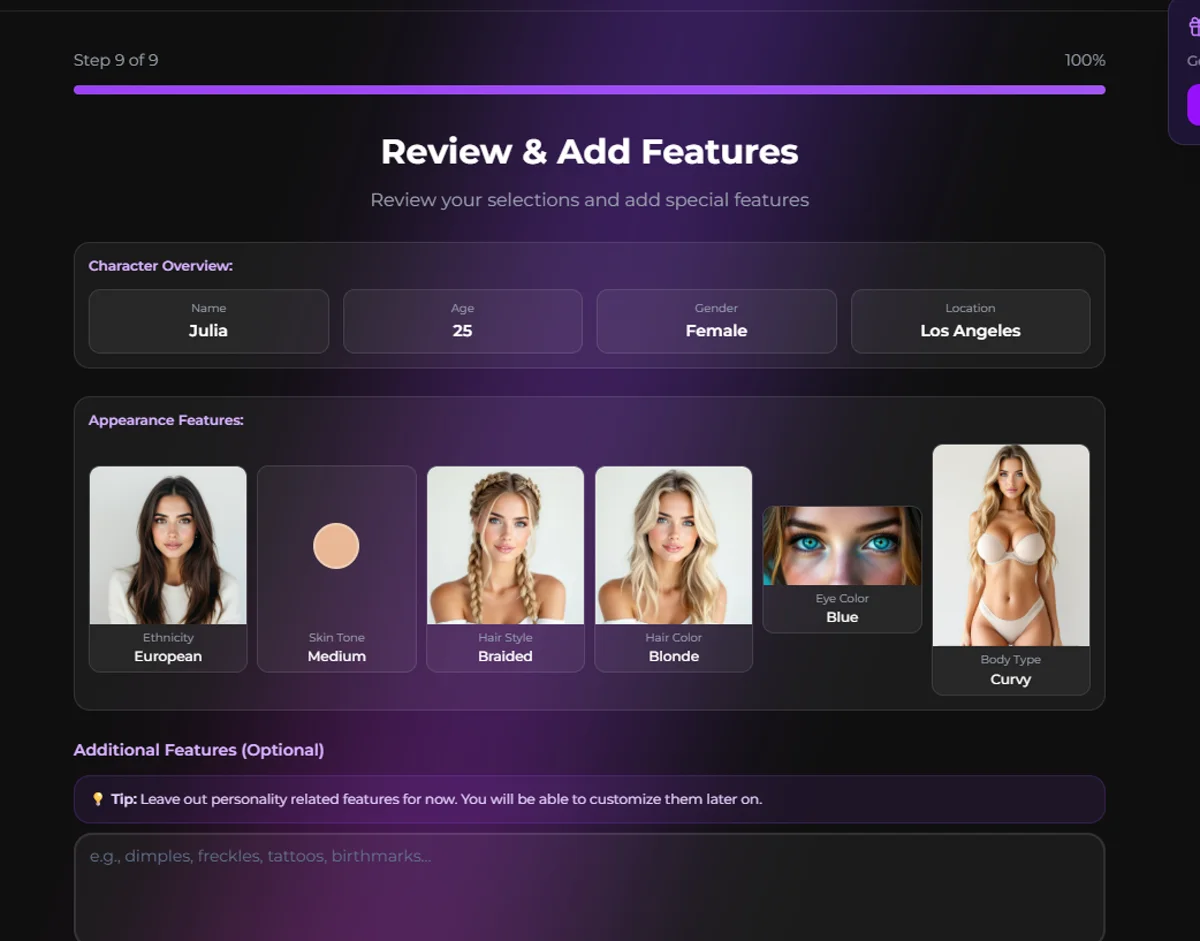
Then comes Additional Features — the free-text box — where you type two or three concrete details: maybe a small tattoo, a scattering of freckles, a specific accessory she's rarely without. Finally, the review screen shows everything you've picked in one place: name, age, gender, location, and all six appearance choices laid out together. You scan it, maybe swap one hair color decision you're second-guessing, and confirm. From opening the wizard to having a fully created companion, the whole thing realistically takes somewhere in the five-to-ten-minute range for someone being deliberate about each choice — faster if you already know exactly what you want.
The Additional Features Box — the step people skip and shouldn't
Alongside the visual pickers, there's an optional free-text Additional Features field, and this is genuinely the most underrated part of the whole process. This is where you type the specific details a swatch grid can't capture: dimples, freckles across the nose, a tattoo on a particular spot, a birthmark, a scar, a beauty mark — anything distinctive that makes a face or body feel like a specific person rather than a generic "pretty woman, brown hair" result.
Why does this matter so much? Because it's the difference between a companion who looks fine and a companion who looks consistent and specific across every image you generate of her later. If you skip this box, you get a solid but generic base. If you fill it in with two or three concrete, specific details, the generator has actual anchors to work from — and those same details are what make her recognizable in every future image and video generation, rather than a slightly different-looking woman every time you hit generate. Specificity here is doing real work, not just flavor text.
A good rule of thumb: pick two or three details, not ten. "Small mole above her lip, a thin silver ring, freckles across her cheeks" gives the generator clear, distinct anchors. Twenty adjectives crammed into one box tends to muddy results rather than sharpen them.
Think of this field the way a casting director thinks about a distinguishing feature, or the way a novelist gives a character one or two physical details that keep recurring in every scene — not an exhaustive physical description, just the handful of specifics that make her instantly recognizable. A birthmark on the collarbone. A particular style of earring she always wears. A tattoo with a specific placement rather than just "has a tattoo." These are the details that survive across dozens of future generations precisely because they're concrete enough for the generator to lock onto consistently, unlike vaguer descriptors like "pretty" or "attractive," which don't give the system anything specific to anchor to.
If you're staring at the box unsure what to type, a few categories reliably work well as anchor details:
- Facial marks — freckles (and where they cluster: nose and cheeks, versus scattered across the face), a beauty mark, dimples when she smiles.
- Tattoos — specific placement and rough style (small script on a wrist, a piece on a shoulder blade) rather than just "has tattoos."
- Birthmarks or scars — a small, specific detail like this does a disproportionate amount of work for recognizability precisely because it's unusual.
- Signature accessories — a particular ring, a necklace she's rarely without, a piercing. These carry over into generated images the same way a physical feature does.
- Small styling habits — something like a consistent nail color or a signature lip color, if that level of detail matters to you.
Two or three from this list, chosen because they genuinely matter to you rather than because the list exists, is the sweet spot.
Common Mistakes to Avoid When Building
A few patterns show up repeatedly among people who end up unhappy with their first build, and almost all of them are avoidable:
- Rushing the visual picker steps. Because each appearance category is a quick click, it's tempting to blow through all six in under a minute. The wizard rewards a little patience — comparing two or three close options before committing produces a noticeably better match to what you actually pictured than clicking the first reasonable-looking option.
- Leaving Additional Features blank. This is the single most common thing people skip because it's optional, and it's also the thing that most affects long-term consistency. Even one or two details is meaningfully better than none.
- Choosing hair, skin tone, and body type independently without checking they cohere. Because each category is its own screen, it's easy to treat them as unrelated decisions. Take a moment after the appearance steps, on the review screen, to look at the combination as a whole rather than as six separate choices.
- Expecting instant, fully-formed personality. As covered earlier, personality isn't part of the appearance wizard — it develops through conversation afterward, and through Personas tools if you're on Ultimate. Going in expecting the build process to hand you a complete character, quirks and all, sets up disappointment that has nothing to do with the tool's actual capabilities.
- Not saving good generation results as future references. Once you're in the Generation Studio, if a particular image nails the look you were going for, that image becomes valuable — upload it as a reference photo for future generations rather than starting from text description alone each time.
One tap and you're on cam with someone new
SexRoulette — free, anonymous, no account needed.
Step 9: Review & Create
The final step is a full review screen — everything you've selected across Name, Age, Gender, Location, and each Appearance Feature laid out in one place before she's actually created. This is your last chance to change your mind on a hair color or swap a body type before it's locked in. Once you confirm, your companion exists, with her own profile, ready for chat, generation, and everything else the platform does.
One thing worth knowing up front: the platform explicitly separates appearance customization (this wizard) from personality customization, which can be added and adjusted later, separately, once you're actually talking to her. You're not expected to nail her entire personality in a nine-step form — you build the look first, then shape the personality through actual interaction and, on higher tiers, dedicated Personas tools.
Want something live instead of pre-recorded? SexRoulette pairs you with a real person on cam in one tap — free, anonymous, no sign-up or history. Tap next any time.
Building vs. Browsing: The Real Trade-Offs
Neither path is objectively "better" — they solve different problems. Here's the honest comparison.
| Factor | Pre-Made Companion (Library) | Custom-Built Companion (Generator) |
|---|---|---|
| Time to start chatting | Under a minute | A few minutes (9-step wizard) |
| Visual precision | Whatever's already been created | Exact — you choose every appearance detail |
| Uniqueness | Shared with anyone else who picked her | Built by you, for you |
| Backstory/bio | Pre-written | You define location/context from the start; personality develops through chat |
| Best for | Trying the platform quickly, casual browsing | A specific look in mind, long-term companion investment |
| Popularity signals | Visible (likes, message counts) to help you choose | None yet — she's new |
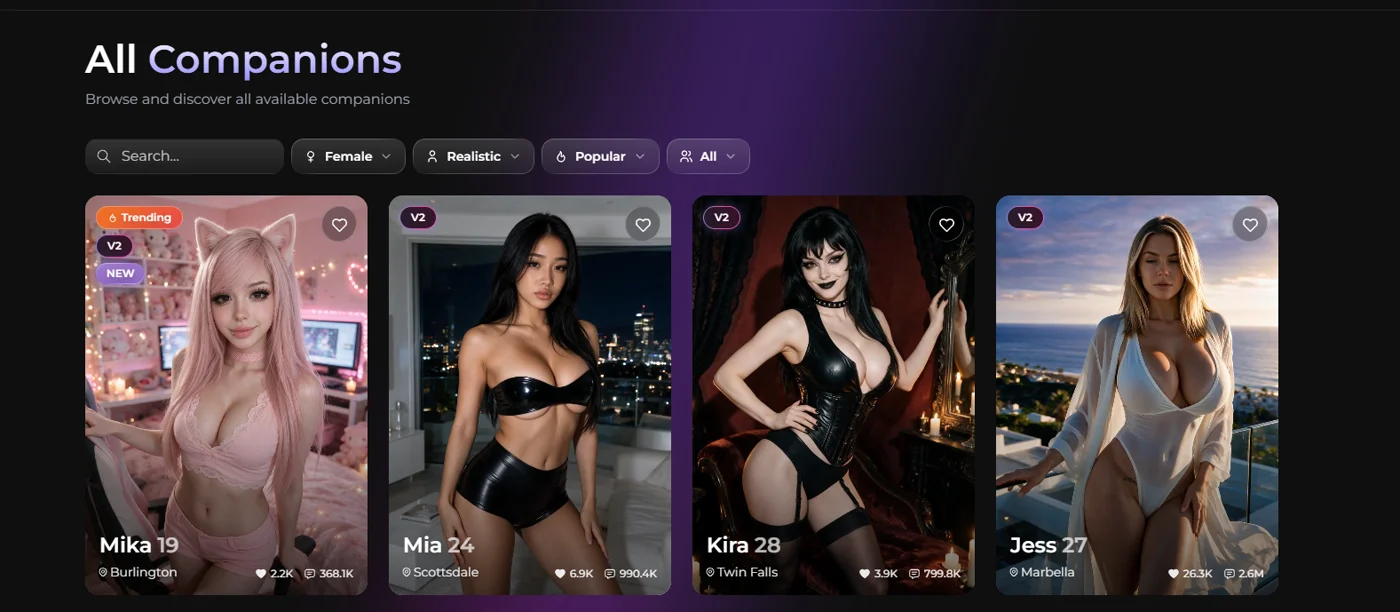
The library isn't a consolation prize, to be clear. Companions like Mika (19, Burlington), Mia (24, Scottsdale), Kira (28, Twin Falls), and Jess (27, Marbella) have racked up genuinely large engagement numbers — Jess alone sits around 26.3K likes and 2.6M messages — which tells you these pre-made characters are extensively developed and well-tested by a huge number of other users already. Browsing the library and seeing which companions have the highest like and message counts is a legitimate way to find a well-loved character fast, and cards are tagged with badges like "Trending," "V2," or "NEW" to help you spot what's currently popular or freshly updated.
If speed and social-proof matter more to you than exact visual precision, browsing wins. If you already know exactly what you want her to look like, building wins. Plenty of users end up doing both — browsing first to get a feel for the platform, then building a custom companion once they know what they actually want. Our best AI girlfriend apps roundup and AI girlfriend apps comparison guide both go deeper on how different platforms handle the browse-vs-build decision if you want more context before committing to one.
Get Matched With Someone Live Right Now
SexRoulette is free and anonymous — no sign-up, no history. Tap next any time.
Start Now →What Happens After Creation
Building her is the start, not the finish. Once your custom companion exists, her profile page gives you a "Start here" action grid with four things you can do immediately:
- New Chat — one-on-one text conversation. This is where personality actually starts to take shape, through how you talk and what you establish about her. Early conversations are a good place to reference the location and any backstory implied by your build choices — asking her about her city, for instance — since it gives the conversation a natural starting point instead of a blank "so, tell me about yourself."
- Group Chat — bring multiple companions (yours and/or others) into a single conversation thread, available on Ultimate. This is a genuinely different dynamic than one-on-one chat — useful if you've built more than one custom companion, or want your custom companion interacting alongside a library favorite.
- Generate — create new images or video of your specific custom companion, using her established appearance as the base. This is the action you'll likely return to most often after the initial build, since it's how you actually see new content of the character you designed rather than just text conversation.
- Call — an AI voice call with her. Worth being precise here: this is voice, not live video — no AI companion platform currently offers genuine real-time video calling, Secrets.ai included, so don't expect a face-to-face video chat experience. Voice calling is still a meaningfully different experience from text chat, though — tone, pacing, and the sense of an actual back-and-forth conversation come through in a way text can't fully replicate.
The Generate action is where the appearance work you did in the wizard actually pays off repeatedly. Every time you generate a new image or video, the generator is working from the specific combination you built — the ethnicity, skin tone, hair, eyes, body type, and whatever you wrote in Additional Features. That's why the free-text details matter so much: they're the throughline that keeps her recognizable across dozens of future generations, not just the first one.
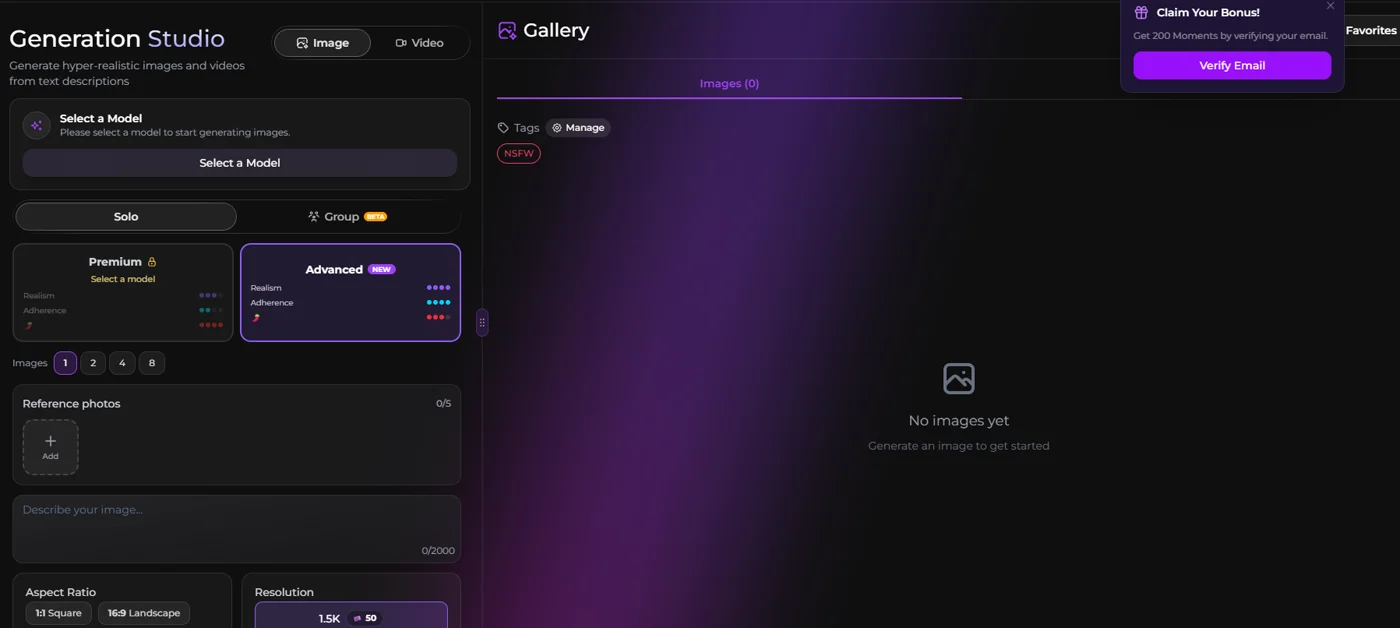
The Generation Studio itself is worth understanding if you plan to build and then generate regularly. You pick between a locked "Premium" model and a newer "Advanced" model, choose Solo or Group (beta) mode, select how many images to generate at once (1, 2, 4, or 8), and can upload up to 5 reference photos to guide the generation further — useful if you want a specific pose or setting to match your companion's established look. You write a text prompt of up to 2,000 characters, pick an aspect ratio (1:1 Square or 16:9 Landscape) and resolution (1.5K), and results land in a personal Gallery where you can tag them — including a built-in "NSFW" tag option. New verified accounts get a bonus of 200 Moments (the platform's credit system for messaging and generation) just for confirming their email, which is enough to start experimenting with both chat and generation right away.
If image and video generation specifically is what you're most curious about, our AI girlfriend that sends pictures and videos guide goes much deeper into the Generation Studio itself — this article is focused on the build process that feeds into it.
One more practical note on discretion, since it comes up often for people building a custom companion for the first time: billing on both plans appears on your card or bank statement as "S LABS INC.," not "Secrets.ai," and you can cancel anytime with no cancellation questions asked. That discretion extends to the build process itself — nothing about creating or naming a custom companion requires connecting real-world identifying information beyond what's needed for account verification.
Personas: adjusting who she is over time
Remember the honest caveat from earlier — personality customization isn't a one-time form, it's ongoing. This is where Personas, included with the Ultimate plan, comes in: dedicated tools for shaping and adjusting a companion's personality and behavior over time, separate from the one-time appearance build. If you're the type of user who wants to keep refining not just how she looks but how she talks, responds, and behaves as your relationship with her develops, Personas is the tier feature built specifically for that ongoing adjustment rather than a single upfront setup — you can see what Personas includes on the Ultimate plan if ongoing personality shaping is a priority for you.
Secrets Shorts: a companion feature worth knowing about even if you build
One more thing worth flagging while we're on the topic of what a companion platform can do beyond static chat and images: Secrets.ai also runs Secrets Shorts, a library of bingeable, episodic mini-drama video series starring the platform's companions, with new episodes dropping weekly. Series follow a real streaming-style premise broken into numbered episodes — "Maid to Please," for instance, follows a hired maid who turns out to be a very different kind of distraction while the wife is away, across episodes like "Hi, I'm Mia," "Time To Seduce," and "Caught Red Handed." Other running series include "My Dirty Stepsister," "Pool Boy," "Off Limits," "My Goth Stepmom," "Love Thy Neighbor," and "Bought and Paid For." The first episode of any story is free to watch, with later episodes unlocking on subscription.
This isn't something you build yourself the way you build a custom companion — it's pre-produced content featuring the platform's own characters — but it's genuinely distinctive in the AI companion space, since most competitors only offer static photo generation rather than scripted, ongoing video series. Worth exploring once you're settled in, even if your main interest is your own custom-built companion.
Free Sex Video Chat — One Tap to Someone Live
SexRoulette is free and anonymous — no sign-up, no history. Tap next any time.
Start Now →Practical Tips for a Companion That Actually Feels Consistent
A few things worth knowing before you sit down to build, based purely on how the generator and generation system are structured:
- Be specific, not exhaustive, in Additional Features. Two or three concrete, distinct details beat a paragraph of adjectives. "Freckles across her nose, a small tattoo on her left wrist" gives the generator clean anchors; a wall of text tends to produce muddier, less consistent results.
- Pick body type and hair together, deliberately. Because both are visual picks in the same flow, it's easy to click through fast. Slow down on these two — they're the features most likely to make later generated images feel "off" if they don't cohere with each other.
- Use reference photo upload once you're generating. The Generation Studio lets you upload up to 5 reference photos alongside your prompt. If a specific generated image nails the look you want, keep it and reuse it as a reference for future generations — it reinforces consistency far more reliably than text description alone.
- Treat personality as a second project, not a checkbox. Don't expect the wizard to hand you a fully-formed personality. Plan on shaping her through actual conversation after creation, and consider Personas if you want dedicated tools for that over time.
- Write the location field like it matters, because it quietly does. A specific city gives early conversations a natural anchor point rather than a blank slate.
- Don't over-generate on your first session. Spend your initial batch of Moments testing a couple of variations of prompts/reference photos rather than burning them all on one setting — you'll learn what phrasing and reference combos actually produce consistent results, and apply that going forward.
Which Plan Actually Makes Sense If You're Building?
If your whole reason for being here is the build-and-generate workflow rather than just chatting, pricing tier matters more than it might for a casual browser, because generation spends Moments and iteration takes more Moments than a single image ever does. Here's how the two tiers actually break down for this specific use case.
| Premium | Ultimate | |
|---|---|---|
| Price (billed yearly) | $2.12/week ($109.99/year) | $6.15/week ($319.99/year) |
| Price (billed monthly) | $4.61/week | $9.23/week |
| Messaging | Unlimited | Unlimited |
| Moments per month | 8,000 | 15,000 |
| Image & video generation | Included | Included |
| AI models | Premium AI models | Everything in Premium |
| Group chats | Not included | Included |
| Personas & advanced customization | Not included | Included |
If you're building one custom companion and mostly chatting with occasional image generation, Premium's 8,000 Moments/month is a reasonable starting point — plenty of room to build, iterate on a few generation batches while you dial in a consistent look, and chat regularly.
If you're planning to actively iterate — generating multiple batches to nail consistency, running group chats with your custom companion alongside others, or using Personas to keep refining her personality over time — Ultimate's 15,000 Moments and Personas access is built specifically for that heavier, ongoing use pattern. The jump in Moments alone (nearly double) matters if you expect to spend real time in the Generation Studio rather than a one-and-done build session.
It's worth thinking about this in terms of what generation actually costs you over time rather than just the sticker price difference. A single build-and-settle session — create your companion, generate a handful of images while dialing in a consistent look, chat regularly — fits comfortably inside Premium's monthly allowance. But if your plan is closer to "build several custom companions" or "generate constantly while refining prompts and reference photos to get exactly the right shot," you'll burn through Moments meaningfully faster, and Ultimate's larger monthly allowance avoids the friction of running out mid-session. Personas is the other factor unique to Ultimate worth weighing here: if ongoing personality refinement matters as much to you as the initial appearance build did, that's a feature Premium simply doesn't include at all, not a smaller version of it.
Either way, both tiers bill discreetly (statements read "S LABS INC.," not "Secrets.ai") and you can cancel anytime with no cancellation questions asked, and the site's current 75% off Summer Finale Sale applies to both. For the full breakdown of every pricing detail and how the tiers compare feature-by-feature, our complete AI girlfriend cost guide covers it in more depth than we have room for here.
How Secrets.ai's Build Process Compares to Other Options
It's worth being upfront about the broader landscape rather than pretending Secrets.ai is the only option. Competitors like Candy AI, Replika, Nomi AI, DreamGF, and Character.AI all offer some form of companion customization, and the category as a whole has matured a lot in the last couple of years. Where Secrets.ai stands out specifically for the build-your-own use case is the combination of three things together: a structured, visual (not text-prompt-dependent) appearance wizard that doesn't require you to know prompt engineering; a free-text Additional Features field that lets you lock in the specific details that make generation results consistent afterward; and Secrets Shorts, the episodic video series feature most competitors simply don't have at all, since most of the field is still limited to static photo generation.
None of that means other platforms are bad choices — plenty of people are perfectly happy with a simpler appearance-slider system or a platform that leans harder into personality depth over visual precision. If you want the full side-by-side, our AI girlfriend apps comparison guide is built exactly for that comparison. But for someone specifically searching "build your own AI girlfriend" because they want granular visual control over the result, Secrets.ai's generator is the more complete tool for that particular job.
Worth noting too: some competitor tools rely heavily on typed prompts even at the build stage, asking you to describe a companion in your own words the way you'd prompt an image generator. That approach can work well if you're comfortable with prompt phrasing, but it puts more of the burden on you to know the right vocabulary to get a specific result. A structured, visual, click-through wizard removes that burden almost entirely — you're recognizing what you want rather than describing it, which is a meaningfully easier task for most people and produces more predictable results on the first try.
If NSFW content specifically is a priority for you as part of the build-and-generate workflow, it's worth reading our NSFW and uncensored AI girlfriend apps guide alongside this one, since generation settings and content policies vary meaningfully between platforms and that's a separate consideration from the build process itself.
Skip the Tube. Talk to a Real Person on Cam.
SexRoulette is free and anonymous — no sign-up, no history. Tap next any time.
Start Now →The Bottom Line
Picking a pre-made companion off a shelf is fine, and for a lot of people it's genuinely the right call — fast, low-effort, and backed by the popularity signals of a huge existing user base. But it's a different experience from building one. When you build, you're not choosing between options someone else created; you're making the actual decisions — ethnicity, skin tone, hair, eyes, body type, and the small specific details that make her recognizable — and then watching a character come together that matches what was in your head rather than what happened to already exist.
The honest caveat still stands: appearance customization is precise and mature, personality customization is something you build through actual conversation and, on Ultimate, dedicated Personas tools over time. Go in with that expectation and the process is genuinely satisfying rather than a letdown. Go in expecting a fully-formed personality to fall out of a nine-step form and you'll be disappointed for reasons that have nothing to do with how good the appearance wizard actually is.
If you already know roughly what you want her to look like, the fastest way to find out whether the build process delivers on it is to actually open the wizard and try — it costs nothing to start, and the current 75% off Summer Finale Sale means there's no better time to test the full platform, generation and all, once you decide to go further than the free build.
Frequently Asked Questions
How long does it actually take to build a custom AI girlfriend?
The nine-step wizard itself takes most people somewhere between three and eight minutes, depending on how long you spend deliberating on each appearance option and how much you write in the Additional Features box. The four identity fields (Name, Age, Gender, Location) go fast; the six Appearance Feature categories take a bit longer since you're browsing visual grids rather than picking from a dropdown, but it's still a guided, linear process rather than an open-ended design task.
Do I need any design or prompt-writing skill to build one?
No. The appearance wizard is entirely visual pickers and swatch grids — you click through options rather than write descriptive prompts. Prompt-writing skill becomes more relevant later, once you're in the Generation Studio writing text prompts (up to 2,000 characters) for new images and video, but even there, uploading reference photos and using the Additional Features details you already set can substitute for prompt-engineering expertise.
Can I change her appearance after she's created?
The wizard itself is a one-time build process for the initial creation, but ongoing image and video generation in the Generation Studio lets you continue producing new looks, outfits, and settings for her afterward using her established base appearance plus new prompts and reference photos. Significant changes to her core defining features are best planned for at the initial build stage, which is why taking time on the Appearance Features and Additional Features steps pays off — think of the wizard as setting the foundation and generation afterward as styling on top of it, rather than expecting to redo the foundation itself later.
What's the difference between appearance customization and Personas?
Appearance customization happens once, during the nine-step build wizard, and covers how she looks — ethnicity, skin tone, hair, eyes, body type, plus free-text details. Personas, included on the Ultimate plan, is a separate and ongoing set of tools for adjusting her personality and behavior over time, used after creation as your relationship with her develops through conversation. They're deliberately separated because appearance is a one-time decision and personality realistically isn't.
Is building a custom companion better than picking one from the library?
Neither is objectively better — they solve different problems. Building gives you exact visual control and takes a few minutes; browsing the library gets you chatting in under a minute with a companion who already has an established look, bio, and (for popular ones) a large track record of likes and messages from other users. If you have a specific look in mind, build. If you want to start fast or see what's popular first, browse. Plenty of people do both over time — browsing first to calibrate what they like, then building once they know exactly what that is — so treat this as a starting point rather than a permanent, exclusive choice.
Will my custom companion look the same every time I generate a new image of her?
Consistency depends heavily on how specific you were during the build, particularly in the Additional Features free-text box — concrete details like a specific tattoo placement or a distinct facial feature give the generator clear anchors to maintain across future generations. Uploading reference photos of results you liked in the Generation Studio (up to 5 per generation) further reinforces consistency. Results are generally more consistent with specific, deliberate build choices than with a rushed setup.
Can I do a voice call with a companion I built myself?
Yes — the Call action is available on any companion, including ones you build from scratch, not just pre-made library companions. It's important to know this is an AI voice call, not live video — no AI companion platform, including Secrets.ai, currently offers real-time video calling, so set your expectations around a voice conversation rather than a face-to-face video chat.
Which pricing tier should I pick if I'm mainly interested in building and customizing?
It depends on how much you plan to iterate. Premium's 8,000 Moments/month covers a solid build-and-generate workflow for someone creating one custom companion and generating occasionally. If you expect to generate heavily to dial in consistency, use group chats, or want ongoing Personas tools to keep shaping her personality over time, Ultimate's 15,000 Moments and included Personas access are built specifically for that heavier use case.
For a broader look at the category before you commit to a platform, our what is an AI girlfriend explainer and AI girlfriend guide are both good starting points, and our AI porn generators guide is worth a look if image generation quality specifically is your main decision factor. And if you're ready to actually build, Secrets.ai's custom generator is free to start and currently running the 75% off Summer Finale Sale described throughout this guide.
SexRoulette
One tap and you're on cam with someone new
SexRoulette — free, anonymous, no account needed.
Try It Free→No sign-up. No history. Tap next anytime.